
Embracing a History that Never Was
As old as the game of golf is, its history in the United States is much shorter. There are references to featherie-era long-nose clubs and balls being delivered to the British colonies in the early 1700s and a few newspaper articles that mention the existence of early golf clubs in Georgia and South Carolina around the same time (they were really predecessors to modern “country clubs”), but the game as we know it today wasn’t really played enough to warrant wide attention and documentation until the 1880s, well after the nearly 400-year span when long-nose clubs and feather-filled balls dominated the game.
With that true history in mind, allow me to introduce you to an imaginary “alternate” history where enjoyment of the game blossomed much earlier in the United States, enabling it to become as popular a pastime in this country by the 1850s as it was in its native Scotland. Played on courses laid out on the true links land of coastal New England down to the Sandhills of North Carolina and on small short courses in town squares everywhere in between, golf on this imaginary timeline was well-loved by young and old in the United States and supplied by a network of club and ball makers utilizing the natural resources available in North America to build equipment for the growing game. It’s from this “history that never was” that the idea of Wulff long-nose golf clubs was born.
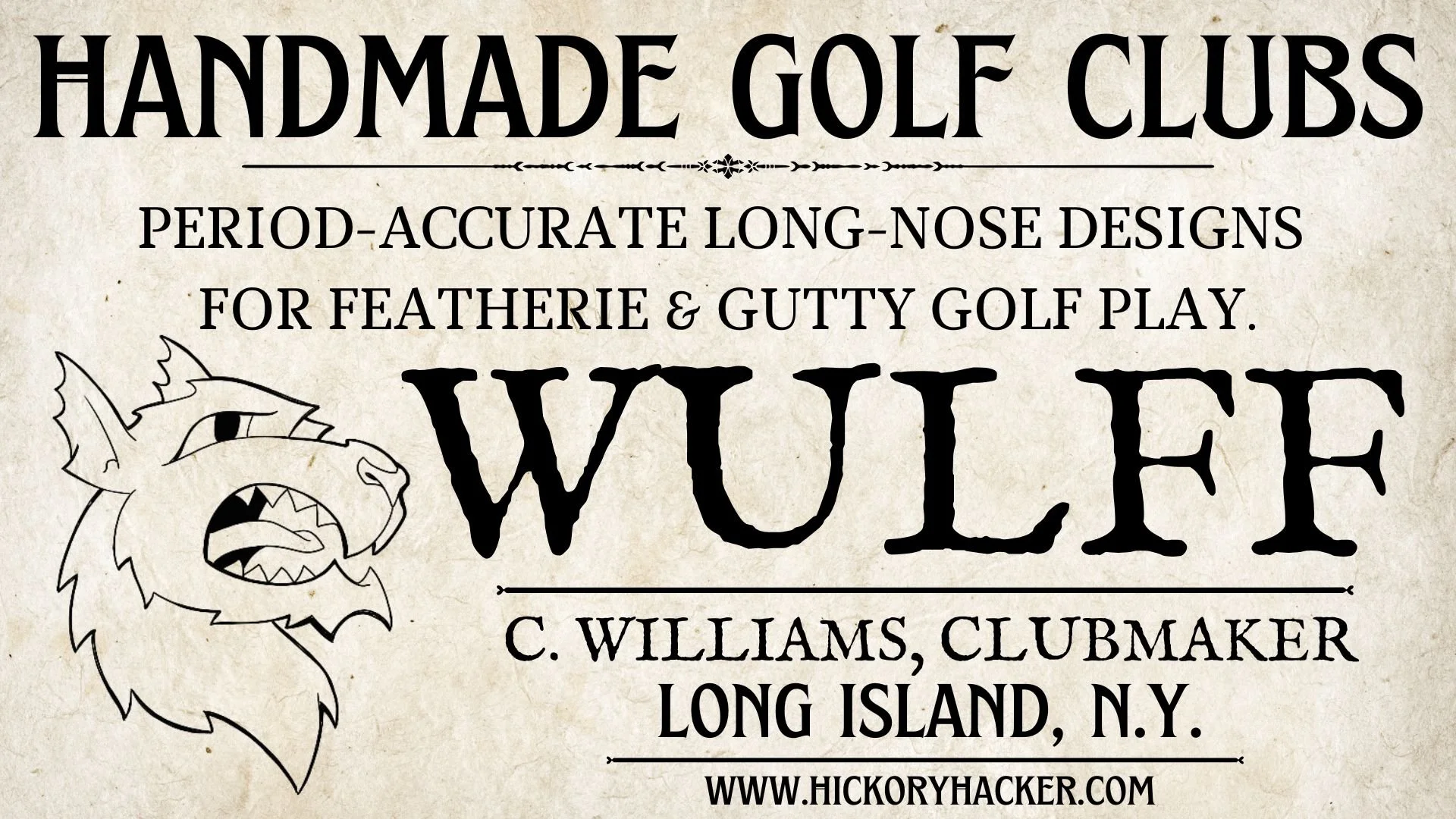
I’m endeavoring to make Wulff long-nose golf clubs from the perspective of a hypothetical club maker living and working on Long Island, NY before the Civil War. With the benefit of hindsight and an awareness of the materials used to make Scottish-born long-nose golf clubs, I limit myself to the natural resources that would have been available to such a North American tradesperson in that era from the hardwood used for the heads, the bone or hardwood for the leading edge, the lead for the weight, the ash or hickory for the shaft, and the animal hides for the grip.
Each Wulff long-nose club design is inspired or based on a template derived from measurements of authentic long-nose clubs, but modified along the way with my own tweaks and aesthetic choices. These are not replicas but rather “new” period-correct long-nose golf clubs — clubs that never existed but could have. And with the exception of one step very early in the process where I use a bandsaw to cut the initial template for the head out of its block, Wulff golf clubs are constructed entirely by hand. In the premium offerings, even the shaft is handcrafted using the tools and techniques utilized by bow makers in the 15th century (the original club makers). Depending on the club, they are playable with the Lane featherie ball, McIntyre Park synthetic gutta percha ball, and any modern low-compression ball (see specific club listings for details).
Generally speaking, availability of these clubs for purchase will be dictated by when I’m satisfied with how they look and play. In other words, I won’t be taking custom orders as I don’t want to burden the creative process of making them with the responsibilities and expectations associated with custom transactions. That said, if you see a club that you like in the web store that has sold, you’ll find an email link where you can be added to a waiting list for notification of when that style of club will be available for sale again. In those cases, I am willing to do limited customizations to suit your preference for loft, finish, and grip type.
Above all, my intent is to provide an affordable and period-correct entry point to playing featherie and gutty golf with handmade, long-nose golf clubs. I hope you enjoy playing them as much as I enjoy making them!
And considering I’m very much an apprentice club maker, if you’re interested in remarkably accurate replicas of authentic long-nose clubs or have very specific custom requirements, I highly recommend you work with my friend Kelly Leonard, who is a modern master in the long-nose club making community and will craft pretty much any replica long-nose golf club to your specifications. Visit Kelly’s website or email him at klhickory@gmail.com and please let him know that Christian sent you.
